In the hallowed halls of museums, a quiet revolution is unfolding. The age-old challenge of presenting three-dimensional cultural relics, especially delicate ancient porcelain, in their full glory is being met with cutting-edge technology.
In the hallowed halls of museums, a quiet revolution is unfolding. The age-old challenge of presenting three-dimensional cultural relics, especially delicate ancient porcelain, in their full glory is being met with cutting-edge technology. This article delves into a groundbreaking application: the use of a flexible LED cylinder screen to create immersive, 360-degree displays of ancient porcelain. We will explore how this innovative solution transcends traditional static cases, allowing visitors to virtually "handle" priceless artifacts, examining every brushstroke, glaze variation, and structural detail without the risks of physical contact, thereby redefining the standards of artifact presentation and public engagement.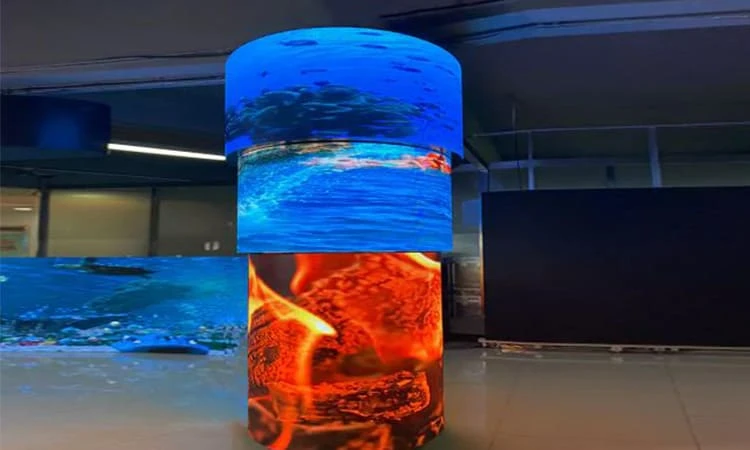
Beyond the Glass Case: The Limitations of Traditional Display
For centuries, museum porcelain has been imprisoned behind glass. This method, while protective, creates a significant experiential barrier. Viewers are fixed to a single, often suboptimal, vantage point. The intricate details on the reverse side, the interior markings, or the subtle curvature of the form remain hidden secrets. Lighting is another constant struggle; glare on glass or poorly angled spots can obscure features rather than reveal them. This passive mode of display treats the artifact as a distant object of reverence but fails to facilitate a deep, investigative connection. It acknowledges the item's historical value but neglects the visitor's innate desire to explore and understand the object's complete material reality, leaving a gap between the artifact's story and the audience's comprehension.
The Technology Unveiled: Anatomy of a Flexible LED Cylinder
At the heart of this transformation is the flexible LED cylinder screen. This is not a simple projection onto a surface; it is a self-illuminating, seamless cylindrical display constructed from flexible LED modules. These modules can be curved into a perfect or near-perfect cylinder, creating a continuous 360-degree canvas. The screen boasts high resolution, ensuring that even the most minute details of high-fidelity 3D scans are rendered with stunning clarity. Its flexibility is key, allowing for various diameters and heights to suit different artifacts and spaces. Furthermore, the screen can be synchronized with interactive sensors or touchscreen kiosks, enabling user-controlled rotation and zoom. This technology transforms the display space from a passive container into an active, dynamic portal for exploration.
A Digital Twin: The Crucial Role of 3D Scanning and Modeling
The LED cylinder is merely the stage; the star is the meticulously created digital twin of the porcelain. This process begins with high-precision 3D scanning, often using photogrammetry or structured light scanners. Hundreds of overlapping photographs are taken from every conceivable angle, capturing not just geometry but also surface texture and color data at an extremely high resolution. This data is then processed to create a photorealistic, rotatable 3D model. Conservators and digital artists work to ensure the model is archaeologically accurate, correcting for no distortions. This model becomes the immutable digital asset—a perfect, permanent record of the object's state that can be studied, shared, and displayed endlessly without risking the original.
Curating the Narrative: From Static Object to Dynamic Story
With the digital model loaded onto the cylinder screen, curators gain a powerful new storytelling tool. The display is no longer a single statement but a programmable narrative journey. A curated sequence can begin with an awe-inspiring full-rotation view, then zoom dramatically into a specific region, such as a painter's signature, a crackle in the glaze, or a complex decorative motif. Annotations, historical context, or diagrams can be overlaid directly onto the rotating image. For example, a celadon vase can be shown whole, then have its surface "peeled away" in an animation to explain the clay body, the underglaze, and the final glaze layer. This guided deconstruction allows curators to highlight scholarly points and craft an educational experience that is both profound and accessible.
Transforming Visitor Engagement: An Interactive Experience
The impact on the visitor is profound. The encounter shifts from observation to interaction. Many setups allow users, via a touch interface, to take control. They can stop the rotation, spin the vase with a finger-swipe gesture, and zoom in to see the pinhole porosity of the glaze or the individual hairs of a painter's brush. This active exploration fosters a deeper cognitive and emotional connection. It satisfies curiosity, empowers learning, and creates a memorable "wow" moment. For younger audiences, this interactive, tech-driven approach is particularly effective, bridging the gap between ancient craftsmanship and modern digital literacy. The artifact is no longer seen as a fragile relic but as a vibrant source of endless discovery.
Preservation and Access: The Dual Mandate Fulfilled
Perhaps the most significant advantage lies in fulfilling the museum's dual mandate: preservation and access. The most fragile porcelains, those too sensitive for permanent light exposure or vibration, can be moved to optimal conservation storage. Their digital twins take their place on the gallery floor, accessible 24/7 without degradation. This technology also democratizes access. Detailed 360-degree views can be made available online for remote scholars, students, or enthusiasts worldwide. It enables comparative studies side-by-side on screen of pieces housed in different continents. Thus, the flexible LED cylinder is not just a display tool; it is a preservation strategy and a global access platform, extending the life and reach of cultural heritage far beyond the museum's physical walls.
In conclusion, the integration of flexible LED cylinder screens represents a paradigm shift in museology, moving artifact presentation from passive exhibition to active, immersive revelation. By marrying precise 3D digital twins with dynamic, interactive display technology, museums can unlock the full narrative potential of ancient porcelain, fostering unprecedented visitor engagement and deeper understanding. This approach brilliantly reconciles the imperative to protect fragile originals with the mission to provide broad, meaningful access. As this technology evolves, it promises to become a standard for showcasing not just porcelain, but any three-dimensional object, setting a new benchmark for educational impact and preservation in the digital age.


