The T-55265GD057J-LW-ADN is a 5.7-inch LCD display panel manufactured by OPTREX Corporation, a brand renowned for its high-reliability industrial display solutions
Core Specifications and Technical Architecture
-
Screen Size and Form Factor: 5.7 inches diagonal, with active area dimensions of approximately 115.2 mm × 86.4 mm. The compact 4:3 aspect ratio is ideal for control panels and portable instrumentation.
-
Display Resolution: 320 × 240 pixels (QVGA). While not high-definition by modern consumer standards, this resolution is purposefully matched to the panel's typical viewing distances and data presentation needs in industrial settings.
-
Panel Technology: The panel utilizes passive matrix STN (Super Twisted Nematic) or FSTN (Film-compensated STN) technology. This choice prioritizes contrast, viewing angle stability, and cost-effectiveness over the fast refresh rates required for video. Many variants of OPTREX 5.7-inch panels feature a white/black or yellow-green background with a wide operating temperature range.
-
Interface and Connectivity: The T-55265GD057J-LW-ADN typically employs a parallel interface, often 8-bit or 16-bit data bus, compatible with common microcontrollers and embedded processors. This interface ensures deterministic data transfer without the latency overhead of serialized video protocols.
-
Optical Characteristics: Expect a contrast ratio optimized for readability under ambient light, combined with a viewing angle of approximately 120° horizontal and 90° vertical (typical). The panel’s response time is suited for static or slowly updating content, such as measurement readings, menu screens, and status indicators.
Engineering for Harsh Environments: The OPTREX Advantage
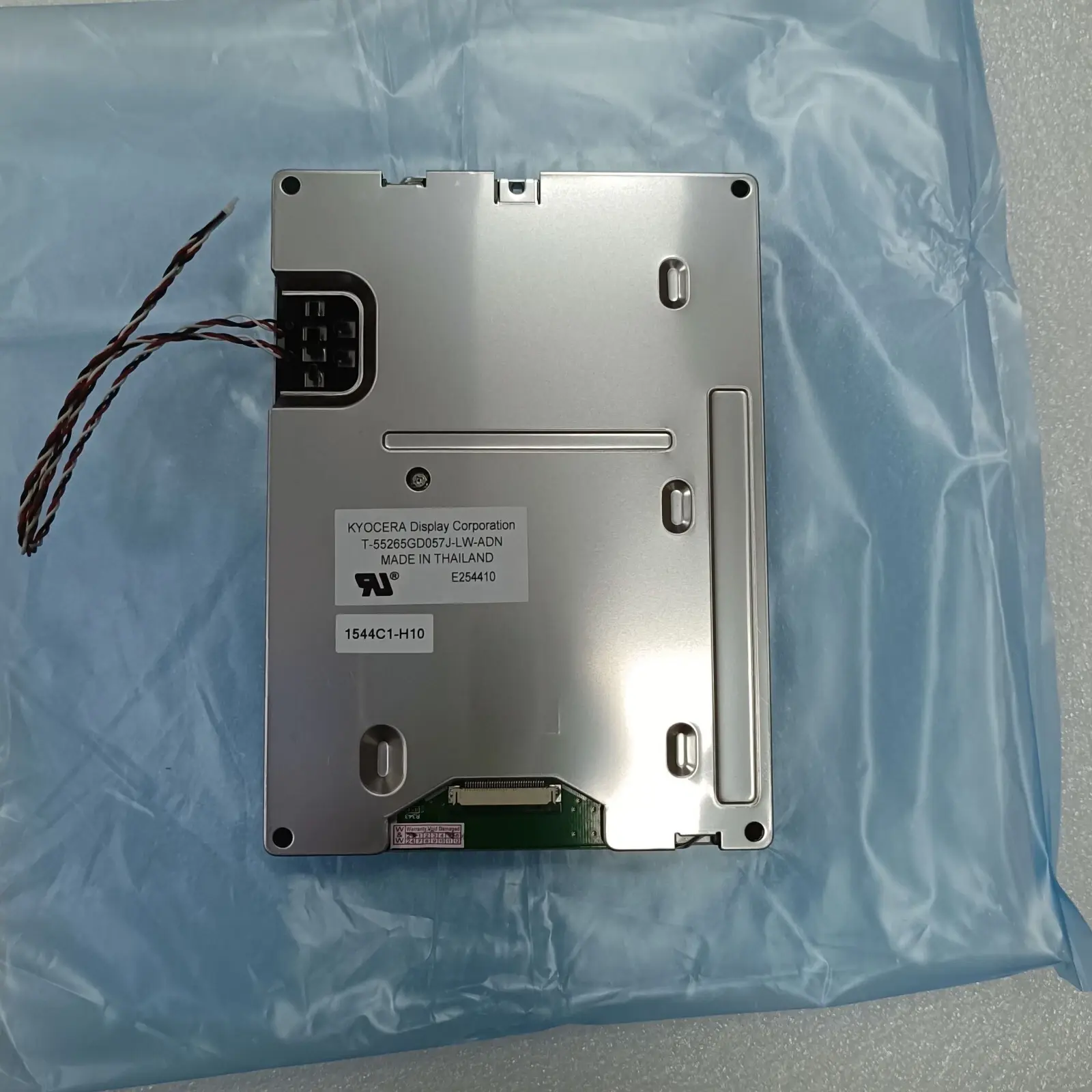
OPTREX has built its reputation on industrial-grade reliability. The T-55265GD057J-LW-ADN is designed to operate reliably across a wide temperature range, typically from -20°C to +70°C (storage) and 0°C to +50°C (operating). This thermal resilience is achieved through robust LCD fluid formulations and temperature-compensated driver ICs. Furthermore, the panel often includes an integrated backlight—commonly CCFL (Cold Cathode Fluorescent Lamp) or long-life LED (depending on the specific revision)—which is replaceable or designed for tens of thousands of operational hours. The mechanical design incorporates metal frame bezels and secure mounting points, reducing susceptibility to vibration and mechanical shock.
Application Suitability: Where This Panel Excels
-
Medical Devices: Patient monitors, diagnostic equipment, and portable ultrasound units benefit from the panel’s stable grayscale rendering and low electromagnetic interference (EMI) profile when properly driven.
-
Industrial Control and Automation: Human-Machine Interfaces (HMIs), CNC control panels, and PLC programming terminals require displays that are legible under factory lighting and resistant to electrical noise. The STN technology’s slower response is not a drawback here; it actually reduces motion artifacts in static displays.
-
Transportation and Infrastructure: Public information kiosks, ticketing machines, and vehicle-based displays (e.g., forklifts, agricultural vehicles) rely on the panel’s wide operating temperature range and immunity to condensation (when paired with proper optical bonding).
-
Test & Measurement Instrumentation: Oscilloscopes, signal analyzers, and bench power supplies use this panel to present waveforms, numeric data, and menu structures with high character legibility.
Comparison with Alternative Display Technologies
When compared to TFT (Thin-Film Transistor) LCD panels of the same size, the T-55265GD057J-LW-ADN offers distinct trade-offs:
-
Contrast and Viewing Angles: TFT panels provide superior contrast and wider viewing angles but at a higher power consumption and cost. The STN panel in this OPTREX model delivers adequate contrast for 90% of typical industrial uses while consuming significantly less power.
-
Response Time: TFT panels are essential for video playback. However, for alphanumeric and graphical static displays, the slower response time of STN is an advantage, as it reduces flicker and simplifies the driving electronics.
-
Reliability and Longevity: The simpler construction of STN panels, without active transistors at every pixel, often results in lower failure rates over time in high-temperature or high-vibration environments.
Another key differentiator is the optical bonding capability. The T-55265GD057J-LW-ADN can be bonded to a touch screen or protective cover glass with optically clear adhesive, drastically improving readabiity under direct sunlight and preventing internal condensation. This practice is common in OPTREX-derived panels but may not be standard with generic equivalents.
Integration Considerations for Design Engineers
Successfully integrating the T-55265GD057J-LW-ADN into a product requires attention to several technical details:
-
Backlight Driver: The panel’s backlight requires a dedicated inverter or constant-current LED driver (if LED-based). Ensure the power supply is isolated and provides stable voltage/current to avoid brightness flickering.
-
Interface Timing: The parallel interface requires careful alignment of data lines, clock, and control signals. Consult the official OPTREX datasheet for exact timing diagrams (e.g., setup time, hold time, and frame rate).
-
Mechanical Mounting: Use the provided mounting holes and avoid applying pressure to the center of the LCD cell. The panel should be supported along its edges to prevent mechanical stress that could cause uneven gaps or color shifts.
-
Thermal Management: If operating near the lower temperature limit, an integral heater may be required. OPTREX often offers “W” or “-T” variants with extended temperature ranges. Verify the part number suffix.
Conclusion: A Proven Investment in Industrial Display Reliability
The T-55265GD057J-LW-ADN is not a flashy consumer display, but it is precisely the kind of robust, predictable, and long-lived component that underpins critical systems in medicine, automation, and transportation. Its combination of QVGA resolution, STN technology, OPTREX quality control, and industrial temperature rating makes it a first-choice solution for engineers who prioritize operational dependability over pixel count. By understanding its technical depth and integration requirements, designers can leverage this panel to build interfaces that remain readable and functional for decades.


