In the demanding ecosystem of industrial automation and human-machine interaction, the choice of a display panel is far from a cosmetic decision; it is a critical determinant of system reliability and operational clarity. Among the myriad of options available
In the demanding ecosystem of industrial automation and human-machine interaction, the choice of a display panel is far from a cosmetic decision; it is a critical determinant of system reliability and operational clarity. Among the myriad of options available, the AUO 10.1-inch LCD Display Screen G101EVT03.3 has established itself as a de facto standard for a wide range of professional applications. This article provides a deep technical analysis of this specific model, moving beyond surface-level specifications to explore its architecture, optical performance, and the engineering rationale that makes it a preferred solution for industrial designers. We will dissect how this panel balances the inherent trade-offs between power consumption, viewing angle stability, and luminance, ultimately explaining its sustained relevance in a market flooded with newer technologies. The following chapters will guide you through its core technology, its real-world performance metrics, integration considerations, and its future-proofing attributes in the context of Industry 4.0.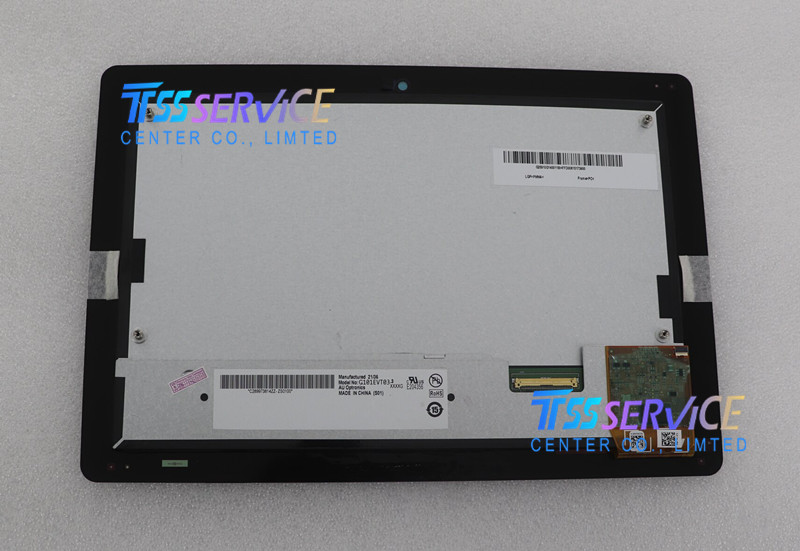
Decoding the Architecture: Why a-Si TFT and LED Backlight Matter
The G101EVT03.3 is built upon an a-Si TFT (Amorphous Silicon Thin-Film Transistor) active matrix. While this is a mature technology, its application in this specific panel is optimized for industrial longevity. Unlike the amorphous silicon found in budget consumer displays, the transistor layer in the AUO panel is engineered for high current stability over extended operational cycles—often exceeding 50,000 hours. This directly translates to reduced threshold voltage shift, a primary failure mode in stressed LCDs, ensuring consistent brightness and response times across years of 24/7 operation.
Furthermore, the backlight unit employs a WLED (White Light Emitting Diode) edge-lit array. The critical differentiator here is not the use of LEDs themselves, but the voltage control and thermal management integrated into the driver circuit. The panel operates on a typical 3.3V logic supply, but the backlight driver is designed to handle a specific voltage range (usually 9.6V to 12.6V). This design choice allows for precise dimming without color shift, a feature often missing in panels that rely on simple pulse-width modulation (PWM). The result is a flicker-free experien ce at low brightness levels, which is paramount for reducing operator eye fatigue in control rooms and production lines.
Another architectural highlight is the LVDS (Low-Voltage Differential Signaling) interface. The G101EVT03.3 utilizes a 20-pin, 1-channel LVDS connector. This is a deliberate decision to ensure signal integrity over moderate cable lengths (up to 1-2 meters) in electrically noisy industrial environments. The differential signaling provides inherent immunity to common-mode interference, ensuring that the image remains stable and free from artifacts even when the display is positioned near high-power motors or RF transmitters.Optical Performance: Precision in Luminance, Contrast, and Viewing Angles
Beyond the raw specifications, the optical behavior of the G101EVT03.3 reveals its industrial DNA. With a native resolution of 1024x600 pixels (WSVGA), it achieves a pixel density that is optimal for reading schematics and monitoring dashboards without causing text to be too small. The aspect ratio of 16:9 is a practical compromise for video feeds from surveillance cameras or inline inspection systems.
The panel boasts a typical brightness of 400 cd/m². However, what is more significant is the uniformity of this luminance. AUO typically specifies a uniformity ratio of 80% or higher, meaning that the delta between the brightest and darkest zones of the screen is tightly controlled. This prevents 'hot spots' and 'clouding' that can obscure critical data. The contrast ratio, often cited at 1000:1, is achieved through a normally black IPS (In-Plane Switching) technology. This is crucial for industrial settings where operators view the screen from various angles.
Speaking of angles, the IPS technology provides a wide viewing cone of 80/80/80/80 degrees (CR≥10). But the true value lies in the color stability across these angles. On a TN panel, a 45-degree lateral shift will cause significant gamma shift and desaturation. The IPS array in the G101EVT03.3 maintains color integrity, so an engineer viewing the screen from the side will see the same alarm status as the operator sitting directly in front. The response time (Tr+Tf) at 25°C is typically 25ms, which is sufficient for dynamic data updates (e.g., moving charts) without objectionable ghosting, though it is not designed for high-frame-rate video playback.
Integration and Environmental Resilience for Harsh Applications
Integrating the G101EVT03.3 into a finished product requires a nuanced understanding of its mechanical and thermal constraints. The panel weighs approximately 200g and has a slim profile, which simplifies enclosure design. However, the operating temperature range of -20°C to +70°C is a primary specification for industrial integrators. This range is achieved through careful selection of the liquid crystal mixture and the use of a robust polarizer that resists thermal deformation.
A key consideration often overlooked is the viewing direction and touch panel bonding. The panel is designed for optimal viewing at 6 o'clock (looking from below). Placing the display above eye level can cause inversion. For resistive or capacitive touch integration, integrators must be aware of the air gap and potential for Newton rings. High-end industrial designs use optical bonding (OCA/OCR) to eliminate the air gap, which not only improves sunlight readability by reducing reflectivity but also enhances the mechanical integrity of the assembly. This bonding process, however, introduces thermal stress; the G101EVT03.3's glass is rated to handle this stress within the specified temperature window.
Furthermore, the panel's connector location (typically on the bottom side) and cable routing must be carefully considered to avoid stress on the flex cable. The LVDS connector is a delicate part; improper mating or excessive bending of the cable near the connector can cause intermittent display failures. Integrators should utilize strain relief and follow AUO's recommended cable routing to ensure long-term reliability in high-vibration environments like factory floors or agricultural equipment.
Future-Proofing and Comparison: Why Not Higher Resolution or OLED?
In an era of 4K mobile phones and OLED televisions, one might question the viability of a WSVGA IPS panel. The answer lies in the specific demands of the industrial lifecycle. The G101EVT03.3 is designed for longevity of supply and stability of optical properties. OLED burn-in is a critical failure mode for static-dominant industrial GUIs (Graphical User Interfaces), while this AUO LCD exhibits virtually no image retention. The 1024x600 resolution is also a sweet spot for legacy SCADA (Supervisory Control and Data Acquisition) software, which was designed for VGA/XGA resolutions and scales poorly to higher pixel densities without significant UI redesign.
Moreover, the market dynamics for 10.1-inch panels are unique. The G101EVT03.3 benefits from a standardized form factor and pin-to-pin compatibility with other AUO models (e.g., the G101EVN01.0 or G101EVT03.4). This cross-compatibility allows designers to create a single PCB layout that can accept multiple panel variants, hedging against obsolescence. While newer panels might offer higher contrast, they often come with newer, less proven interfaces (e.g., eDP or specific MIPI variants) that require more complex timing controllers. The LVDS interface of the G101EVT03.3 is a proven, widely understood standard that reduces development risk and NRE (Non-Recurring Engineering) costs.
Finally, the power consumption, typically under 5W for the entire module, remains highly competitive. It is significantly lower than older CCFL-backlit industrial panels and consumes less power than a high-resolution display running at the same brightness, because there are fewer pixels to drive. This makes it an ideal choice for battery-backed edge computing devices or portable diagnostic equipment where every milliwatt matters.
The AUO G101EVT03.3 is not merely a display; it is a rigorously engineered tool for clarity and reliability in the industrial sector. Its value proposition rests on the proven stability of its a-Si TFT backplane, the color-accurate viewing cone of its IPS technology, and its robust environmental tolerance that ensures years of flicker-free operation. While consumer trends chase pixel density, this panel excels where precision, longevity, and system integration simplicity are paramount. For any engineer architecting a human-machine interface for a factory floor, medical cart, or outdoor kiosk, the G101EVT03.3 remains a benchmark for maturity and performance—a testament that in industrial design, dependability often outweighs novelty.


