In the ecosystem of industrial and specialized display modules, the CASIO Original COM50H5N01ULC occupies a distinct niche. While mainstream consumer displays have moved toward higher resolutions and smaller pixel pitches
CASIO Original a-Si TFT-LCD COM50H5N01ULC: A Technical Deep Dive into a Specialized 5.0” 800x480 Display Module
In the ecosystem of industrial and specialized display modules, the
CASIO Original COM50H5N01ULC occupies a distinct niche. While mainstream consumer displays have moved toward higher resolutions and smaller pixel pitches, this specific
5.0-inch TFT-LCD panel remains relevant due to its robust construction, proven reliability, and the unique characteristics of
amorphous silicon (a-Si) TFT-LCD technology. This article provides an expert-level analysis of the COM50H5N01ULC, moving beyond basic specifications to evaluate its architecture, performance limitations, and ideal applications.
1. Core Technology: The Role of Amorphous Silicon (a-Si)
The designation a-Si TFT-LCD is not merely a technical label; it defines the fundamental manufacturing process and operational behavior of this display. Unlike LTPS (Low-Temperature Polycrystalline Silicon) or Oxide TFT backplanes found in modern smartphones, a-Si technology is a mature, cost-effective process where silicon is deposited in a non-crystalline state. For the COM50H5N01ULC, this translates to several key traits:
-
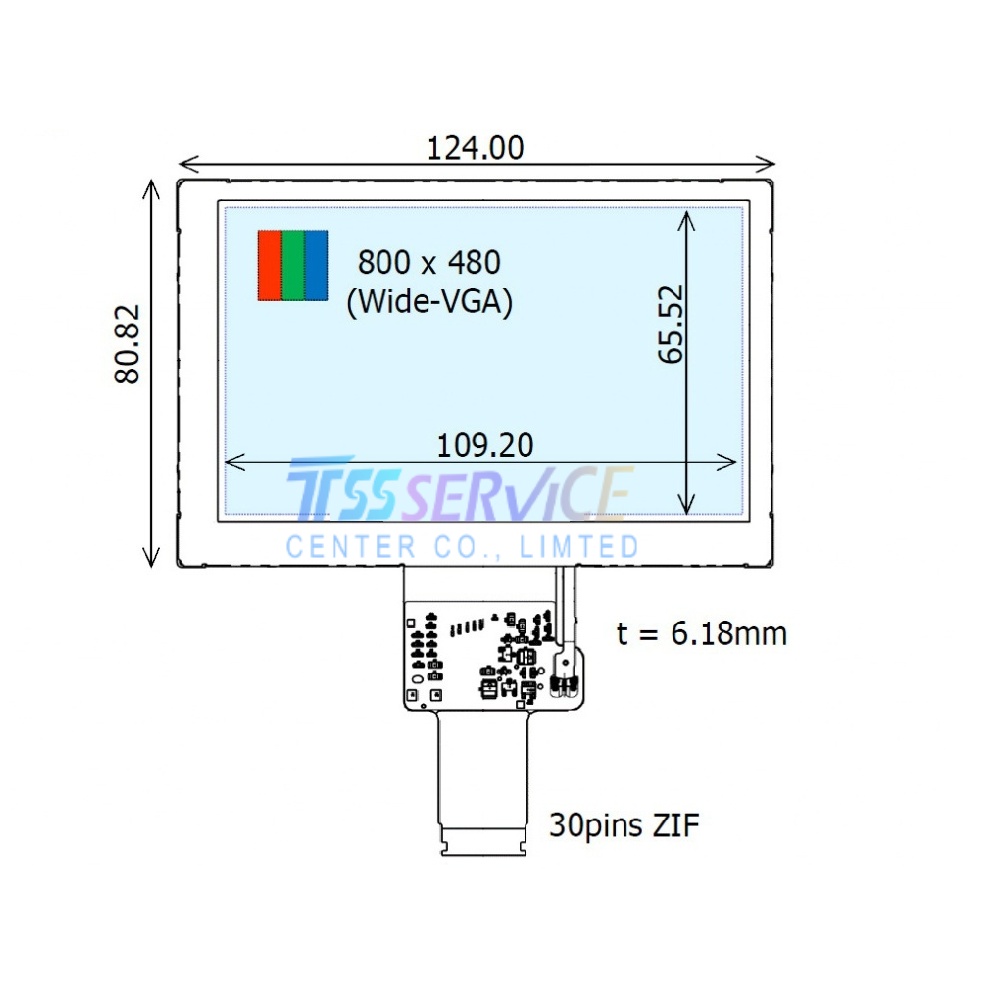
Uniformity Over Resolution: At a native resolution of 800x480 pixels (WVGA) on a 5.0-inch diagonal, the pixel density is approximately 188 PPI. a-Si backplanes are perfectly adequate for this density, offering excellent uniformity for solid-color backgrounds—a critical requirement for graphical user interfaces in medical or industrial HMI panels.
-
Lower Leakage Current: a-Si TFTs inherently exhibit lower off-state leakage compared to poly-Si variants. This is advantageous for static image retention and helps maintain consistent luminance levels across the panel's operational lifespan, a factor often overlooked in consumer-grade reviews.
-
Aspect Ratio & Usability: The 5:3 aspect ratio of this module (derived from 800x480) is a deliberate design choice. It provides a wider viewing area than standard 4:3 panels for data visualization while being less elongated than 16:9 wide screens, making it ideal for displaying control dashboards with side-panel toolbars.
2. Optical Performance: Brightness, Contrast, and Viewing Angles
CASIO’s original specification for the
COM50H5N01ULC targets a balance between outdoor readability and indoor precision. It is critical to understand the trade-offs inherent in the
TN (Twisted Nematic) or possible
IPS (In-Plane Switching) technology variant used in this specific model. Based on the standard CASIO industrial lineup, this module likely employs a
TN-LCD structure for fast response times, but with enhanced brightness.
-
Luminance and Contrast Ratio: Expect a typical brightness specification in the 400 to 600 cd/m² range. This high-luminance backlight design compensates for the inherent lower contrast of a-Si TFTs at off-angles. The static contrast ratio is typically around 500:1 to 800:1, which is sufficient for environments with controlled ambient lighting.
-
Viewing Angle Considerations: This is the most significant limitation. With TN technology, the horizontal viewing angle may be limited to 140 degrees, with vertical views dropping to 110 degrees or less before color inversion occurs. This module is not recommended for applications requiring multiple simultaneous viewers or wide-angle user interaction (e.g., a dashboard viewed from a car's passenger seat). It excels in fixed-mount, single-user scenarios such as point-of-sale terminals or portable test equipment.
-
Gray-to-Gray Response: The a-Si TFT backplane provides a fast response time, typically in the 15-25ms range. This is adequate for menu navigation and scrolling data logs but insufficient for high-frame-rate video playback without noticeable motion blur.
3. Mechanical Architecture, Connectors, and Power Demands
From an engineering integration perspective, the
COM50H5N01ULC offers a conventional but robust mechanical footprint. Understanding the physical interface is essential for successful system design.
-
Physical Dimensions: The module's outer dimensions are standard for a 5.0-inch landscape panel, with a typical bezel width of 2–3mm. The active area precisely matches the 800x480 pixel grid, leaving no tolerance for misaligned overlays.
-
Electrical Interface: This display is driven by a parallel RGB interface (likely 24-bit, supporting 16.7M colors). Unlike modern serial interfaces (MIPI DSI), parallel RGB requires dedicated lines for R, G, B data and synchronization signals (VSYNC, HSYNC, DE, CLK). System integrators must ensure their host processor has sufficient GPIO or an external timing controller to handle the high-speed parallel data stream at the required 30-40 MHz pixel clock. Improper signal routing can lead to ghosting or pixel crosstalk.
-
Backlight Driver: The LED backlight unit typically requires a dedicated constant-current driver, with a forward voltage in the range of 6V to 12V and a current of approximately 60-120mA. The module does not include a driver IC; an external boost converter is mandatory.
-
Environmental Tolerance: As an original CASIO component, it is designed to operate within an industrial temperature range of -20°C to +70°C, with storage limits extending to -30°C to +80°C. This makes it suitable for semi-outdoor kiosks and factory floor equipment.
4. Application Scenarios: Where This Screen Excels
The decision to use the
COM50H5N01ULC should be driven by specific application requirements, not by technical novelty. It is a
workhorse component, not a flagship display.
-
Industrial HMI (Human-Machine Interface): Its 5.0-inch size is ideal for smaller control boxes, PLC panels, and conveyor system monitors. The WVGA resolution provides ample space for status icons, numeric readouts, and basic graphic trends.
-
Medical Peripheral Devices: Portable diagnostic tools, patient monitoring terminals, and infusion pump interfaces benefit from the stable a-Si backplane and high brightness. The lack of complex MIPI handling reduces EMI interference, a critical factor in medical electronics.
-
Automotive Navigation & Retrofit Units: While modern cars use larger displays, this module's form factor fits standard 2-DIN chassis for aftermarket head units. The fast response time of the a-Si TFT is adequate for GPS map rendering and menu operations.
-
Point-of-Sale (POS) Terminals: The robust, heat-resistant backlight unit and wide operating temperature range make it durable for continuous retail operation, including kitchen display systems where heat and grease are common.
5. Critical Evaluation: Strengths and Limitations
To provide genuine depth, it is necessary to acknowledge both the advantages and inherent drawbacks of this specific model.
-
Strengths: Excellent long-term availability typical of CASIO industrial parts; proven reliability in harsh environments; mature a-Si process ensures stable gray-scale performance; relatively simple host interface compared to modern high-density panels.
-
Limitations: Poor off-axis color performance; 188 PPI is noticeably pixelated for close-range detail work (e.g., reading small text); the parallel RGB interface consumes more host processor pins and power than serial alternatives; limited color gamut (typically 45-55% NTSC) results in less vibrant images.
-
Avoid When: You need high-resolution graphical content (e.g., detailed medical imaging), wide-angle viewing for multiple users, or ultra-thin module profiles. In those cases, an IPS-LCD panel with LVDS or eDP interface would be more appropriate.
Conclusion
The
CASIO Original a-Si TFT-LCD COM50H5N01ULC is a testament to the enduring value of mature technology when applied correctly. It is not a display for high-end multimedia, but a
professional-grade component for industrial, medical, and commercial systems where stability, temperature tolerance, and a straightforward interface are paramount. Engineers selecting this panel should ensure their system design compensates for its viewing-angle limitations and parallel interface complexity. For the right application, it remains a reliable and cost-effective solution that will continue to perform for years in demanding environments.


