In the rapidly evolving landscape of wearable technology, a persistent challenge has been the seamless integration of rigid, brittle electronics with the soft, dynamic contours of the human body.
In the rapidly evolving landscape of wearable technology, a persistent challenge has been the seamless integration of rigid, brittle electronics with the soft, dynamic contours of the human body. This fundamental mismatch has limited the design and functionality of everything from smart clothing to advanced health monitors. Now, a significant breakthrough from South Korea is poised to redefine the very fabric of wearable displays. Researchers have successfully developed a highly stretchable LED technology, a leap forward that promises to move displays from being merely worn to becoming truly woven into our daily lives.
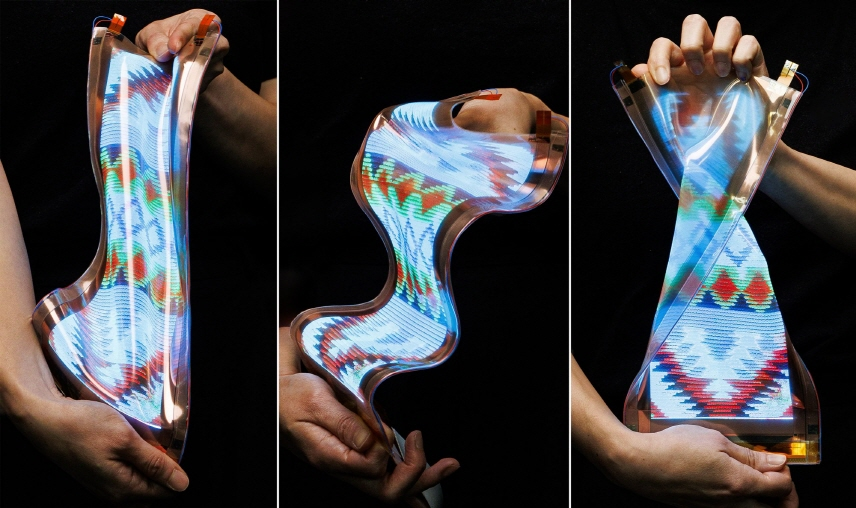
This innovation is not merely a flexible screen; it is a display that can stretch, twist, and conform like a second skin. This article delves into the core technology enabling this feat, explores its transformative applications across key industries, and examines the profound implications it holds for the future of human-computer interaction
.
The Science of Elastic Light: Core Technological Breakthroughs
The development of stretchable LEDs represents a monumental engineering challenge, requiring a complete rethinking of traditional display architecture. Conventional LEDs are built on rigid substrates like glass or silicon, which fracture under strain. The Korean breakthrough hinges on two key innovations. First, researchers have pioneered the use of ultra-thin, serpentine interconnects—wiring that meanders in a wavy, spring-like pattern. When the substrate stretches, these interconnects simply straighten out rather than break, maintaining electrical continuity.
Second, and more critically, is the development of the light-emitting component itself. Teams have made significant progress with inorganic micro-LEDs, transferring microscopic light-emitting chips onto a pre-stretched elastic substrate like polydimethylsiloxane (PDMS). When the tension is released, the substrate contracts, causing the micro-LEDs to buckle and form a wavy, stretchable network. Alternatively, advances in organic LED (OLED) materials have yielded intrinsically flexible and stretchable light-emitting polymers. The synergy of these material science and structural design innovations creates a display that can withstand strains of over 30% without losing functionality or brightness.
Beyond Wristbands: Transformative Applications Across Industries
The true value of this technology unfolds in its application potential, which extends far beyond the current paradigm of smartwatches and fitness trackers. In healthcare and biomonitoring, stretchable LED displays can be integrated into adhesive epidermal patches that conform perfectly to skin. These could provide real-time, graphical visualization of vital signs—such as an EKG waveform or blood oxygen level—directly on the patch, offering unprecedented at-a-glance health data for patients and clinicians.
In the realm of advanced wearables and fashion tech, the possibilities are revolutionary. Imagine athletic wear with dynamic, stretchable displays that show performance metrics, or haute couture with fabrics that change color and pattern on command. For the military and aerospace sectors, this technology enables conformal displays on curved cockpit surfaces, soldier uniforms for situational awareness, or even adaptive camouflage. Furthermore, it paves the way for more immersive augmented reality (AR) interfaces that can be seamlessly integrated into flexible visors or even contact lenses in the future.
The Human-Machine Interface Redefined: Implications and Future Trajectory
The advent of stretchable LED technology signals a paradigm shift in how we interact with digital information. It moves us from interacting with devices to interacting with environments and even our own bodies. The interface becomes invisible, ambient, and intuitive. This has profound implications for accessibility, allowing for interfaces that can be tailored to any surface or form factor. It also pushes the boundaries of robotics, enabling sensitive electronic "skins" that provide visual feedback on a robotic limb.
However, the path to commercialization is not without hurdles. Key challenges that researchers and engineers must now address include:
-
Long-term durability: Ensuring the displays can withstand repeated stretching cycles, moisture, and UV exposure without degradation.
-
Power efficiency and sourcing: Developing equally flexible and durable batteries or energy-harvesting systems to power these displays autonomously.
-
Manufacturing at scale: Translating lab-scale precision processes into cost-effective, high-volume production methods.
Overcoming these obstacles will be the next critical phase in bringing this futuristic vision to market.
In conclusion, Korea's development of stretchable LED technology is far more than an incremental improvement; it is a foundational innovation that dissolves the physical barrier between electronics and the organic world. By mastering the science of elastic light, it unlocks a new dimension of applications in healthcare, wearable tech, and beyond, fundamentally redefining the human-machine interface. While challenges in durability and manufacturing remain, this breakthrough illuminates a clear path toward a future where displays are no longer separate objects, but adaptive, integral parts of our clothing, our tools, and our very environment. The era of truly seamless wearable technology is on the horizon.


