Imagine a world where your car's windshield transforms into a dynamic information hub, seamlessly overlaying navigation arrows onto the road, highlighting potential hazards invisible to the naked eye, and even translating foreign road signs in real-time. This is no longer the stuff of science fiction. In a groundbreaking collaboration, Japanese electronics giant Kyocera and automotive titan Toyota have jointly developed a revolutionary transparent OLED (Organic Light-Emitting Diode) display designed specifically for automotive windshields.
This partnership merges Kyocera's expertise in high-precision ceramic packaging and fine-pitch display technology with Toyota's deep knowledge of vehicle integration, safety, and human-machine interface. The development signals a pivotal leap toward making augmented reality (AR) a core, integrated component of the driving experience. This article delves into the technology behind this innovation, explores its transformative potential for drivers and automakers, and examines the significant challenges that must be overcome to move from prototype to production, ultimately painting a picture of a fundamentally altered relationship between driver, vehicle, and the road.
The Fusion of Giants: Kyocera's Tech Meets Toyota's Vision
The collaboration between Kyocera and Toyota is a classic case of synergistic innovation. Kyocera brings to the table its proprietary fine-pitch transfer technology. This allows for the placement of microscopic OLED elements with extreme precision onto various substrates, a critical capability for creating large, seamless, and transparent displays. Furthermore, Kyocera's heritage in ceramics is vital for developing durable, heat-resistant packaging that can survive the harsh automotive environment—vibrations, extreme temperatures, and prolonged UV exposure.
Toyota's role extends far beyond being merely a client. The automaker provides the essential real-world context: stringent safety standards, ergonomic requirements, and deep insights into driver behavior. Toyota's focus is on how the technology integrates into the total vehicle architecture—ensuring it doesn't obstruct vision, functions reliably over a 15-year vehicle lifespan, and presents information in an intuitive, non-distracting manner. This fusion ensures the technology is not just impressive in a lab but viable for the road.
Deconstructing the Technology: How Transparent OLED Works
At its core, a transparent OLED display emits its own light when an electric current passes through organic compound layers. Unlike conventional LCDs that require a backlight (which blocks transparency), each pixel in an OLED can be turned on or off independently, allowing light from the real world to pass through the inactive areas. The Kyocera-Toyota advancement lies in the engineering scale and robustness.
They have developed a display with high enough pixel density to render sharp, readable graphics and text, while maintaining a high degree of transparency so the driver's view of the road remains uncompromised. The display is likely embedded within the laminated glass of the windshield, protected from the elements. Key technical hurdles overcome include achieving sufficient brightness to be visible in direct sunlight (high luminance) and ensuring a fast enough response time to keep AR elements anchored to the moving real world without lag, which is crucial for safety.
Beyond Navigation: Transformative Use Cases for Windshield AR
While projecting turn-by-turn directions onto the road is the most immediate application, the potential uses are far more profound. Safety augmentation stands out: the system could highlight pedestrians emerging from blind spots, outline the edges of the road in heavy fog, or warn of an unexpectedly decelerating vehicle several cars ahead. For advanced driver-assistance systems (ADAS), it could visually depict the vehicle's "awareness," showing the detected lane markings or the path planning of an autonomous driving system, building driver trust.
Beyond safety, it enables contextual information layering. Imagine identifying points of interest, seeing real-time parking availability, or having hazard warnings (like black ice) displayed directly where the condition exists. For commercial fleets, it could show fuel efficiency tips or delivery information. This transforms the windshield from a passive viewport into an interactive, situational awareness multiplier.
The Human-Machine Interface Revolution: Reducing Cognitive Load
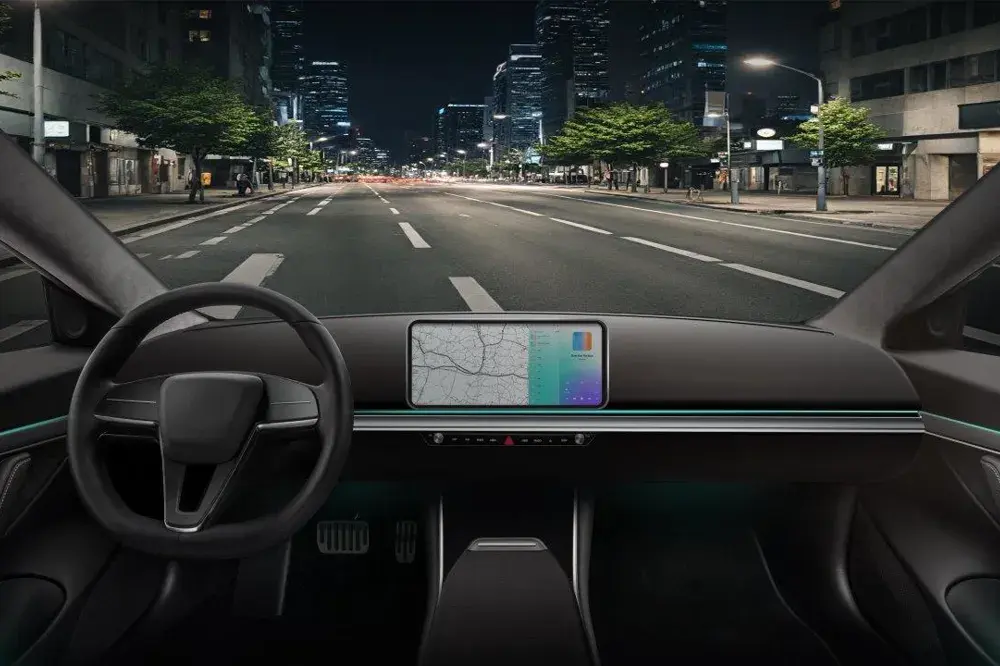
A primary design philosophy behind this technology is the reduction of cognitive load. Currently, drivers must constantly shift their focus between the road and dashboard displays (for speed, navigation) or center consoles (for alerts). This split-second diversion, known as visual displacement, is a known safety risk. By projecting key information directly into the driver's line of sight—a concept known as a Head-Up Display (HUD) but at a vastly more immersive scale—the technology allows drivers to maintain situational awareness.
Information is assimilated almost subconsciously. The driver no longer needs to "look down"; speed, navigation cues, and warnings are contextually overlaid on the environment. This creates a more intuitive and seamless interaction with the vehicle's systems, potentially reducing reaction times and driver stress, especially in complex or unfamiliar driving scenarios.
Significant Hurdles on the Road to Production
Despite the exciting promise, the path from a successful prototype to a series-production option is fraught with challenges. Cost is paramount; the fine-pitch technology and durable materials must become economical for mass-market vehicles. Manufacturing scalability is another; producing large, defect-free transparent displays for millions of cars annually is a monumental task.
Safety and regulatory approval will be intensely scrutinized. Regulators will demand exhaustive proof that the displays do not cause distraction, glare at night, or obstruct vision in any driving condition. Content prioritization and standardization is also critical. Automakers and UI designers must establish strict rules about what information is displayed, when, and how, to avoid information overload. Finally, ensuring long-term reliability against sun damage and thermal cycling remains a key engineering frontier.
The Broader Impact: Redefining the Automotive Experience and Industry
The successful commercialization of windshield AR will fundamentally redefine the cabin experience. The traditional instrument cluster may become obsolete, freeing up dashboard space for new design paradigms. The windshield becomes the primary interface, shifting value in the supply chain towards companies that master display and projection technology, like Kyocera.
For automakers like Toyota, it offers a powerful brand differentiation and a new revenue stream through software-driven features and services delivered via the AR platform. Furthermore, it is an enabling technology for autonomy. In semi-autonomous vehicles, it keeps the driver informed and engaged. In fully autonomous "passenger" vehicles, the entire windshield could transform into an entertainment or workspace screen, revolutionizing interior design and the very purpose of time spent in a vehicle.
FAQs: Kyocera and Toyota's Windshield AR Technology
1. What did Kyocera and Toyota actually develop? They co-developed a prototype transparent OLED display designed to be integrated into a car's windshield to project augmented reality (AR) information directly into the driver's line of sight.
2. How is this different from a current Head-Up Display (HUD)? Traditional HUDs project onto a small combiner or a limited section of the windshield, showing basic data. This is a large, transparent screen enabling complex, full-windshield graphics that can interact with and overlay onto the real-world view.
3. What are the main benefits for drivers? Enhanced safety through hazard highlighting, reduced distraction by keeping eyes on the road, intuitive navigation with arrows painted on the road, and improved situational awareness.
4. Won't this be distracting? A core goal is to reduce distraction by presenting information contextually and within the driver's focal point. Proper UI design and strict information prioritization are critical to avoid overload.
5. Can you see the display in bright sunlight? Achieving high brightness (luminance) is a key technical challenge the partnership has focused on, making the display visible in all lighting conditions.
6. When will this be available in production cars? No official timeline has been announced. It is currently a prototype, and significant hurdles in cost, manufacturing, and regulation must be solved before series production.
7. Will it work at night? Yes, but the brightness and contrast will need to automatically adjust to prevent glare and preserve night vision, a standard feature for modern HUDs.
8. What happens if the display fails? Like any critical vehicle component, it must be designed for extreme reliability. As part of the laminated windshield, its failure likely wouldn't impair the basic structural or viewing properties of the glass itself.
9. Is this only for self-driving cars? No. It has immense value for human drivers today. It is also considered a complementary technology that will build trust and improve interaction as vehicles become more automated.
10. Who are the main competitors in this space? Other automotive suppliers (like Continental, Denso, and Panasonic) and tech companies (such as WayRay) are also developing similar AR-HUD technologies, making this a highly competitive and innovative field.
Conclusion
The joint development of a transparent OLED windshield by Kyocera and Toyota represents far more than a novel display technology. It is a foundational step toward a new era of human-vehicle interaction, where the boundary between the digital and physical worlds gracefully dissolves for enhanced safety, comprehension, and convenience. By addressing the dual imperatives of advanced electronics and automotive-grade durability, this collaboration has provided a credible path forward.
While substantial challenges in cost, regulation, and mass production remain, the prototype proves the concept's viability. As the technology matures, it promises to reshape not only the driver's experience but also the automotive industry's competitive landscape and revenue models. The road ahead is being literally and figuratively redrawn, with information seamlessly integrated into our journey, making driving safer, more efficient, and intuitively connected to the world around us.


