The automotive cockpit is undergoing a radical transformation, evolving from a functional space into a personalized, immersive digital hub. At the heart of this revolution lies display technology, where innovation directly shapes the driver experience and vehicle aesthetics
The automotive cockpit is undergoing a radical transformation, evolving from a functional space into a personalized, immersive digital hub. At the heart of this revolution lies display technology, where innovation directly shapes the driver experience and vehicle aesthetics. In a significant move set to redefine this landscape, LG Display has announced its plan to commence mass production of a novel, flexible P-OLED and LED hybrid display specifically for automotive applications in 2026.
This announcement is more than a product launch; it signals a strategic leap towards solving key industry challenges. By merging the strengths of two distinct technologies, LG Display aims to deliver unprecedented design freedom, superior visual performance, and robust reliability, setting a new benchmark for the screens of tomorrow's intelligent vehicles.
Deconstructing the Hybrid: The Synergy of P-OLED and LED
To understand the significance of this development, one must first dissect the components. P-OLED (Plastic OLED) utilizes a plastic substrate instead of glass, granting it remarkable flexibility and ultra-thin, lightweight properties. It offers perfect black levels, high contrast ratios, and wide viewing angles, ideal for critical driver information and entertainment screens. However, achieving extreme brightness for optimal sunlight readability can be a challenge for OLEDs.
This is where the LED component comes into play. LG Display's innovation integrates a high-efficiency LED layer, likely serving as a local dimming backlight or for specific high-luminance zones. This hybrid architecture creates a best-of-both-worlds scenario:
-
Visual Finesse & Flexibility: The P-OLED layer delivers stunning color and deep blacks for most content.
-
Power & Peak Brightness: The LED layer can boost peak brightness dramatically for HDR content and sunlight visibility without excessively taxing the OLED pixels, improving efficiency and longevity.
-
Design Freedom: The flexible plastic substrate allows for curved, bent, or even wrap-around displays, enabling designers to create seamless, futuristic dashboards and pillar-to-pillar screens.
Beyond the Screen: Reshaping Automotive Interior Design and UX
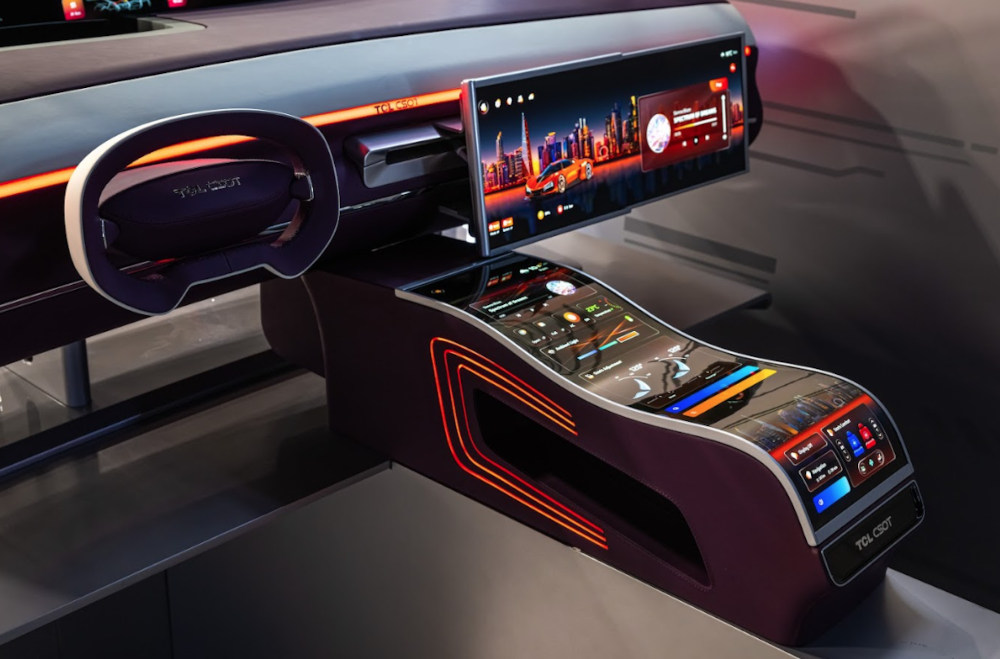
The implications of this flexible hybrid technology extend far beyond mere specification sheets. It fundamentally alters the relationship between the display and the vehicle's interior. The rigid, rectangular screen becomes an anachronism, replaced by organic forms that blend into the cabin's architecture. Imagine a continuous, curved display surface that flows from behind the steering wheel to the center console, or a flexible screen elegantly integrated into a curved door panel or passenger-side entertainment zone.
This paves the way for a new era of adaptive user interfaces. The physical form factor of the display can change contextually—curving around the driver for an immersive, focused mode, or flattening to share content with a passenger. It enables smarter space utilization, allowing for larger screen real estate without the clunky feel of a large slab of glass. The combination of OLED's perfect blacks and LED's punchy brightness also means interfaces can be both cinematic and crystal-clear under any lighting condition, enhancing both safety and engagement.
The 2026 Horizon: Strategic Implications and Market Competition
LG Display's 2026 timeline is strategic. It aligns with the automotive industry's development cycles for next-generation electric vehicle platforms slated for the latter half of this decade. By targeting this horizon, LG is positioning its hybrid display as the centerpiece for the "software-defined vehicle" cockpit. Carmakers designing their flagship 2027-2028 models are now presented with a compelling, production-ready display solution that addresses critical pain points: form, function, and durability.
This move also intensifies the competition in the automotive display arena, where companies like Samsung Display (with its rigid and flexible OLEDs) and BOE are formidable players. LG's hybrid approach presents a differentiated value proposition, potentially offering a more balanced performance profile than pure OLED solutions, especially for large-area applications. Success will hinge not just on technical prowess but on forming deep partnerships with automakers to co-create the cockpit ecosystems of the future, integrating this advanced canvas with vehicle software, ADAS data, and user personalization.
LG Display's commitment to mass-producing a flexible P-OLED+LED hybrid display marks a pivotal moment in automotive technology convergence. It transcends incremental improvement, offering a holistic solution that marries superior visual performance with transformative design potential. As vehicles become more autonomous and connected, the interior experience becomes paramount, and this technology provides the essential canvas. By 2026, this innovation is poised to move from concept to reality, steering the industry toward cockpits that are not just digital, but dynamically sculpted, visually breathtaking, and intelligently adaptive to every journey.


