In the realm of industrial automation, medical instrumentaition, and rugged embedded systems, the display is often the most critical interface between human operators and complex machinery. While consumer-grade screens prioritize vivid colors and ultra-fast refresh rates for entertainment
In the realm of industrial automation, medical instrumentation, and rugged embedded systems, the display is often the most critical interface between human operators and complex machinery. While consumer-grade screens prioritize vivid colors and ultra-fast refresh rates for entertainment, the industrial sector demands a fundamentally different set of characteristics: reliability, durability, optical clarity under harsh lighting, and long-term availability. The NEW KCG075VG2BH-G00 from Kyocera, a 7.5-inch TFT LCD panel with a native resolution of 640×480 pixels, represents a deliberate design philosophy focused on these exact priorities. This article explores the technical architecture, operational advantages, and strategic value of this specific display, moving beyond surface-level specifications to examine why such a panel remains indispensable in high-stakes environments where failure is not an option. We will dissect how its seemingly modest resolution serves a purpose, how its construction addresses real-world environmental stresses, and why its selection can dictate the success of a long-term industrial deployment.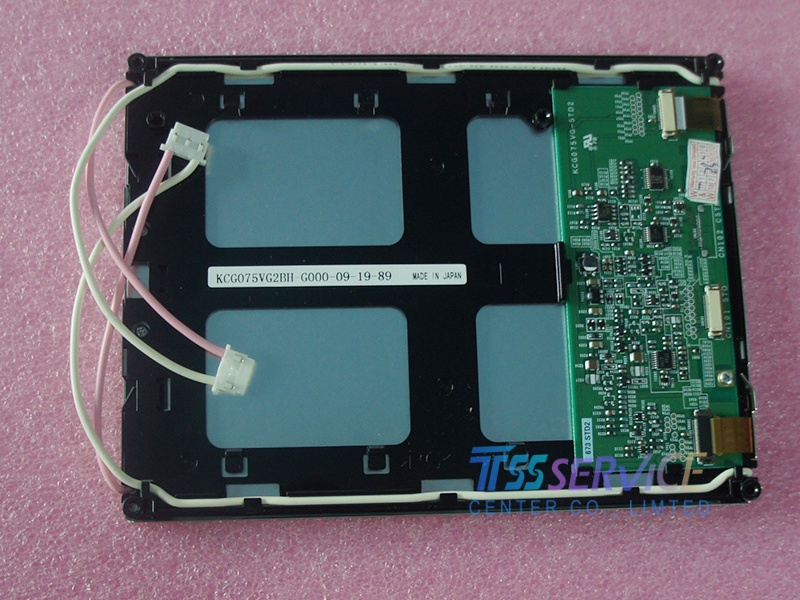
Architectural Precision: Balancing Resolution with Readability
At first glance, a 640×480 (VGA) resolution on a 7.5-inch diagonal screen may appear dated in an era of 4K microdisplays. However, this choice is a calculated engineering trade-off. The KCG075VG2BH-G00 operates with a pixel density that prioritizes legibility and viewing angle stability over pixel count. In an industrial context—such as a factory floor monitor or a patient vital signs display—the operator is often at a fixed distance, and the critical requirement is that characters, symbols, and numeric values are crisp and instantly readable without scaling artifacts. The 0.240mm dot pitch (typical for this size/resolution combination) provides a comfortable balance, ensuring that text remains sharp while preventing eye strain during prolonged shifts. Furthermore, the 640×480 ratio aligns perfectly with legacy machine vision systems and SCADA interfaces that were originally designed for standard VGA inputs, allowing for seamless integration without costly signal conversion or UI redesign. This panel utilizes TN (Twisted Nematic) technology, a choice that delivers exceptionally fast response times (often in the 10-15ms range) and superior transmittance, which directly contributes to its brightness capabilities. While IPS panels offer wider viewing angles, TN’s superior light efficiency allows Kyocera to achieve higher luminance output without increasing backlight power consumption—a crucial factor in environments with high ambient light.
Environmental Resilience: Built for the Unforgiving Worksite
The true differentiator of the KCG075VG2BH-G00 lies not in what it shows, but in how it withstands the environment around it. Industrial LCD panels must survive temperature extremes, vibration, and sustained operation that would destroy consumer electronics. Kyocera engineers have specifically designed this module to operate reliably across a wide temperature range, typically from -20°C to +70°C, with storage capabilities extending further. This is achieved through the use of specialized liquid crystal mixtures and robust mechanical frame construction that prevents thermal expansion from distorting the glass or causing pixel misalignment. The panel’s backlight system is another critical component. The KCG075VG2BH-G00 typically employs a high-luminance LED backlight rated for a prolonged lifetime (often exceeding 50,000 hours to half-brightness). This longevity is not accidental; it results from careful thermal management and the use of premium LED dies that maintain consistent color temperature as they age. Additionally, the surface treatment of the polarizer is engineered to reduce glare and resist minor abrasions, ensuring that the display remains readable even when installed near heavy machinery or in semi-outdoor kiosks. For integrators, this translates to lower mean time between failures (MTBF) and reduced warranty service costs over the product’s lifecycle.
System Integration: Signal Integrity and Mechanical Flexibility
Deploying the KCG075VG2BH-G00 into a final product requires careful attention to its signal interface and physical mounting. This model typically supports a parallel 18-bit RGB interface (often with a 40-pin connector), which provides a robust, low-latency connection suitable for real-time control systems. Unlike high-speed serial interfaces like LVDS or eDP, parallel RGB is highly deterministic and easier to implement on microcontroller-based systems without dedicated video decompression engines. This makes the panel an ideal choice for embedded designs running bare-metal firmware or simple RTOS environments. From a mechanical perspective, the module’s thickness and mounting hole pattern are standardized, allowing for easy replacement in existing designs or straightforward integration into custom bezels. The panel also includes a well-defined optical bonding option, crucial for preventing condensation between the cover glass and the LCD cell in humid or rapidly changing temperatures. For designers, this means the panel can be bonded to a touch sensor or protective glass with minimal optical degradation, improving sunlight readability and impact resistance. The availability of detailed mechanical drawings and electrical timing specifications from Kyocera further reduces integration risk, enabling engineers to prototype and validate their enclosure designs with confidence.
Supply Chain and Longevity: A Strategic Asset for OEMs
Perhaps the most undervalued aspect of the KCG075VG2BH-G00 is its strategic role in product lifecycle management. In the industrial and medical sectors, products often have sales cycles of five to ten years or more, and requalifying a display mid-cycle can be extremely costly, requiring new EMI testing, optical certifications, and mechanical validation. Kyocera has a recognized reputation for providing long-term product availability and stability of specifications. Choosing this panel is a commitment to supply chain continuity. Unlike consumer panels that are end-of-lifed after 18 months, the KCG series is supported with a clear longevity promise, which allows OEMs to build their products with confidence. Furthermore, the display’s standardized resolution and interface mean that it is not locked into a single proprietary controller. Multiple alternative driver boards and cables exist, creating a competitive secondary market. This lowers the risk of obsolescence. For procurement teams, this translates into predictable pricing and reduced risk of last-time-buy emergencies. The panel’s consistent electrical characteristics also reduce the need for frequent firmware updates to adjust timing parameters, simplifying field support and maintenance. In essence, the KCG075VG2BH-G00 is not just a component; it is a logistical anchor that stabilizes the entire product program.
Conclusion
The KCG075VG2BH-G00 from Kyocera is a masterclass in functional design, where ruggedness, readability, and reliability take precedence over flashy specifications. Its 640×480 VGA resolution is not a limitation but a purposeful choice that ensures seamless integration and crisp readability in demanding environments. From its thermally robust construction and extended backlight life to its predictable parallel interface and strategic long-term availability, this panel offers a holistic solution for engineers who cannot afford downtime or field failures. For any organization designing equipment for factory automation, medical diagnostics, or transportation interfaces, this display represents a sound investment in performance stability and supply chain security. It is a reminder that in industrial design, the most effective technology is often the most proven, not the most novel.


