In the rapidly evolving landscape of automotive lighting, a new frontier is being illuminated. Osram, a global leader in photonics, has unveiled a groundbreaking innovation: a color-tunable OLED taillight.
In the rapidly evolving landscape of automotive lighting, a new frontier is being illuminated. Osram, a global leader in photonics, has unveiled a groundbreaking innovation: a color-tunable OLED taillight. This technology represents a paradigm shift, moving beyond static, single-function lights to a dynamic, communicative surface. This article delves into the significance of this launch, exploring not just the technical marvel but its profound implications for vehicle design, safety, and the very language of communication between cars on the road.
The core of this revolution lies in the fusion of two advanced technologies: Organic Light-Emitting Diodes (OLEDs) and sophisticated tunability. Unlike conventional LEDs, OLEDs are surface emitters, creating a homogenous, glare-free light perfect for sleek, signature lighting designs. Osram's breakthrough integrates this with a color-tuning capability, allowing a single OLED module to seamlessly shift its output across a spectrum of red and amber hues.
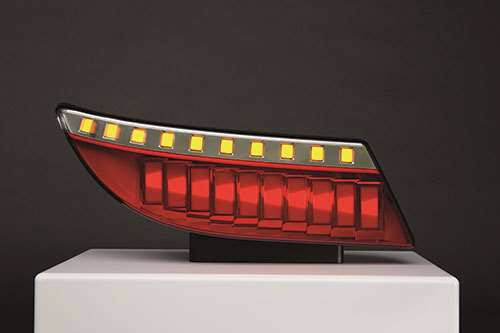
This technical leap is made possible by a multi-layer OLED structure and precise electronic control. The result is a single, elegant light source that can function as a tail light, a brake light, and a dynamic turn signal—all without the need for separate, segmented components. This integration paves the way for thinner, more minimalist lamp designs while offering unprecedented flexibility to automakers. The light becomes a canvas, transforming from a steady red glow to a pulsating amber arrow, all with smooth, eye-catching transitions that enhance aesthetic appeal and functional clarity.
The implications of a dynamic light surface extend far beyond aesthetics; they herald a new era in vehicle-to-vehicle (V2V) communication and proactive safety. A static brake light conveys one binary piece of information: "I am stopping." A color-tunable OLED array can communicate intent and intensity. Imagine a scenario where the taillight intensifies to a deeper, pulsating red during emergency braking, providing a more urgent visual cue to following drivers. Similarly, turn signals could incorporate dynamic sweeping patterns that intuitively indicate the direction or even the lane-change maneuver of the vehicle.
This enriched visual language reduces cognitive load for human drivers and provides a more structured data stream for the sensors of autonomous vehicles. It transforms the taillight from a passive indicator into an active communication node, potentially reducing reaction times and preventing accidents. Osram's technology is a critical step toward making cars more intelligible to their surroundings, bridging the gap between human intuition and machine perception on increasingly complex roads.
Osram's launch is not merely a product release; it is a strategic catalyst poised to reshape the entire automotive lighting value chain and design philosophy. For automakers, it offers a powerful tool for brand differentiation, enabling unique, adaptive lighting signatures that become a core part of a vehicle's identity. Designers are liberated from the constraints of fixed lamp shapes, able to integrate lighting seamlessly into the rear fascia as a dynamic design element.
For the supply chain, this shift demands closer collaboration between semiconductor experts, lighting engineers, and automotive OEMs from the earliest design stages. The "light" is now a smart, software-controlled system. Furthermore, this technology aligns perfectly with the trends toward electrification and digitalization, where customizable user experiences and advanced driver-assistance systems (ADAS) are paramount. It sets a new benchmark, compelling the entire industry to view exterior lighting not as a commodity, but as a central, intelligent interface for the connected vehicle.
Osram's color-tunable OLED taillight is a transformative innovation that redefines the role of automotive lighting. By merging homogeneous OLED aesthetics with dynamic color control, it enables superior design integration, enriches safety through intuitive V2V communication, and stimulates a new wave of automotive design thinking. As this technology moves toward production, it promises to make our roads safer, our vehicles more expressive, and the dialogue between them infinitely more sophisticated. The future of automotive lighting is no longer just about illumination—it's about information.


