In the relentless push toward Industry 4.0, the human-machine interface (HMI) has evolved from a simple command panel into the critical nervous system of industrial operations.
In the relentless push toward Industry 4.0, the human-machine interface (HMI) has evolved from a simple command panel into the critical nervous system of industrial operations. At the heart of this transformation lies a component often overlooked but absolutely vital: the display screen. The TC101BM02-08E 10.1 inch LCD Display Screen represents a specific engineering response to the harsh realities of factory floors, medical environments, and outdoor kiosks. Unlike consumer-grade tablets designed for entertainment, this display is engineered for persistence and precision. This article deconstructs the technical architecture of the TC101BM02-08E, exploring its optical performance, interface compatibility, environmental resilience, and integration logic. By understanding this component not as a generic screen but as a tailored solution for high-stakes environments, we uncover why industrial designers choose specific specifications over general-purpose alternatives, ensuring reliability where failure is not an option.
Optical Architecture: Beyond Brightness to Viewability
The raw luminance of a display is often mistaken for quality, but in industrial contexts, usable brightness is the true metric. The TC101BM02-08E delivers a typical brightness of 1000 cd/m², a figure that immediately distinguishes it from standard consumer panels which typically hover around 250-300 cd/m². This high brightness is non-negotiable for direct sunlight readability, a common requirement for outdoor ticketing machines or marina radar displays. However, the engineering nuance lies in the anti-glare treatment and optical bonding process. Without optical bonding, an air gap between the cover glass and the LCD panel creates internal reflections that wash out the image, effectively halving the perceived contrast. The TC101BM02-08E likely utilizes direct bonding (either OCA or OCA-free), which eliminates this air gap, significantly improving sunlight viewability and mechanical robustness. Furthermore, the 1280x800 resolution on a 10.1-inch diagonal provides a pixel density (approximately 149 PPI) sufficient for displaying critical schematics, detailed process flow diagrams, or video feeds from endoscopes without the pixelation that can lead to operator misinterpretation. The IPS (In-Plane Switching) technology ensures consistent color and contrast across an 85/85/85/85 degree viewing cone, allowing operators to read data from sharp angles without gamma shift, a necessity when the screen is mounted in recessed or awkward positions.
Interface Engineering: The Data Communication Backbone
An industrial display is only as useful as its ability to integrate into legacy and modern control systems. The TC101BM02-08E is designed around the LVDS (Low-Voltage Differential Signaling) interface, specifically a 2-channel 6-bit configuration typical for 10.1-inch panels. While newer systems are moving toward eDP (Embedded DisplayPort), LVDS remains the workhorse of industrial computing due to its simplicity, low electromagnetic interference (EMI), and proven long-term reliability in noisy electrical environments. The pinout of this specific model is critical for design engineers. It typically includes a 40-pin connector with clear allocation for differential data pairs (RX0-RX3), clock signals, and additional lines for control functions like backlight enable and PWM brightness control. The PWM control is a key differentiator; it allows the system to communicate precisely with the LED driver backlight unit, enabling smooth dimming from 100% down to below 10%. This is essential for night-shift use in control rooms or medical environments where maintaining dark adaptation is critical. Importantly, the display does not include a touch sensor or on-screen display (OSD) board; it is a pure optical panel. This means the integrator must provide these external components, allowing for customization of touch technology (resistive, capacitive, IR) and OSD parameters based on the specific environmental demands—for instance, using resistive touch in wet environments or IR touch in sterile labs.
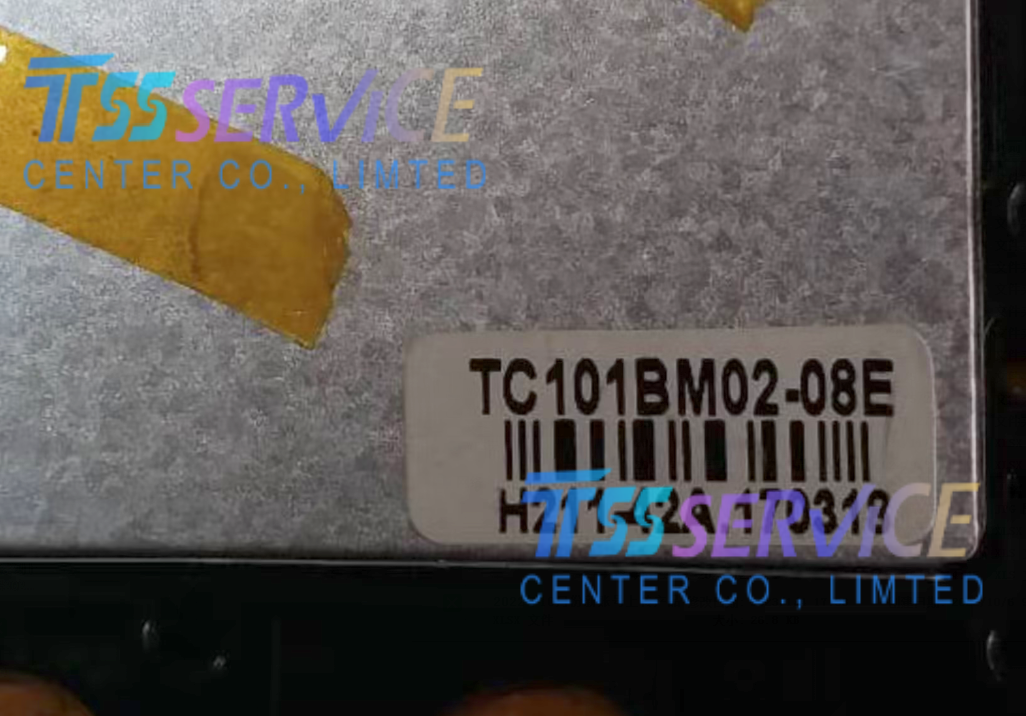
Environmental Durability: Designed for the Front Lines
The materials science behind the TC101BM02-08E is arguably its most undervalued attribute. Industrial displays must survive temperature extremes, vibration, and chemical exposure that would decimate a consumer tablet. The operating temperature range typically spans from -20°C to +70°C, with storage extending to -30°C to +80°C. This is achieved through the selection of industrial-grade ICs (Integrated Circuits) for the timing controller and the use of a custom-tailored liquid crystal mixture that maintains response speed at low temperatures. Below 0°C, standard liquid crystals can freeze or become sluggish, resulting in ghosting artifacts. The TC101BM02-08E dielectric formulation mitigates this, ensuring refresh rates remain stable even in cold warehouse loading bays. Additionally, the unit employs a dual-LED backlight bar rather than a single strip. This redundancy means that if one LED fails—an inevitable event over tens of thousands of hours—the screen does not go dark; it simply dims slightly, providing a graceful degradation that allows the system to continue operating until scheduled maintenance. The bezel is typically finished with a matte texture and is constructed from robust materials to withstand impact, and the module's thin profile (under 5mm) aids in fitting into sealed enclosures where space is a premium.
Integration Intelligence: From Panel to System Solution
Selecting the TC101BM02-08E is not the final step; it is the beginning of a critical system-level integration. The most common integration pathway involves pairing this display with a custom HDMI-to-LVDS converter board and a compatible single-board computer like a Raspberry Pi, NVIDIA Jetson, or an industrial x86 motherboard. The integrator must match the LVDS clock frequency (typically around 70 MHz for 1280x800 at 60Hz) with the source resolution. A mistake in the converter board's EDID (Extended Display Identification Data) programming will result in a blank screen or unstable image. Furthermore, the backlight power supply must be current-controlled, as the LED strip requires a constant current (typically 250-350mA) across the series of LEDs to ensure uniform brightness and prevent thermal runaway. The physical mounting is equally specific; the panel includes mounting brackets on the metal frame that accept M3 screws on a standard VESA-like pattern, but the exact dimensions (often 60x70mm or 75x75mm for 10.1-inch panels) must be verified against the enclosure design. Heat management is also crucial: the backlight LEDs generate heat that must be dissipated through the metal chassis, or actively cooled in enclosed spaces above 50°C. A successful integration treats the display not as a peripheral, but as a component governed by thermal, electrical, and optical constraints that must be engineered into the system's core architecture.
Conclusion The TC101BM02-08E 10.1-inch LCD display is a masterclass in industrial engineering, prioritizing optical clarity, interface robustness, and environmental resilience over consumer-focused metrics like bezel size or pixel density. Its high 1000 cd/m² brightness, IPS viewing angles, and LVDS interface make it a versatile backbone for HMIs, medical carts, and outdoor kiosks. However, its true value is unlocked through careful system-level integration—matching the correct converter, managing thermal loads, and selecting appropriate bonding and touch solutions. For engineers and product managers, this display represents a reliable, cross-generational platform that can withstand the demands of continuous operation, ensuring that the interface between human and machine remains clear, responsive, and dependable for years to come. Choosing the TC101BM02-08E is not simply a display selection; it is a commitment to operational integrity.


