In an era dominated by LED-backlit screens and high-resolution panels, the specialized niche occupied by legacy display technologies often goes unnoticed. Yet, for countless industrial, medical, and avionic applications, stability, reliability, and precise optical characteristics remain non-negotiable.
In an era dominated by LED-backlit screens and high-resolution panels, the specialized niche occupied by legacy display technologies often goes unnoticed. Yet, for countless industrial, medical, and avionic applications, stability, reliability, and precise optical characteristics remain non-negotiable. The OPTREX T-51512D121J-FW-A-AB stands as a testament to this fact. This 12.1-inch TFT-LCD module, equipped with a Cold Cathode Fluorescent Lamp (CCFL) backlight, represents a critical component for systems where proven performance outweighs the allure of modern power efficiency. This article delves into the technical architecture, operational parameters, and practical considerations surrounding this specific display. Rather than treating it as an obsolete part, we will examine its design philosophy, its specific interface requirements, and the nuanced challenges of integrating a CCFL-based panel into contemporary electronic ecosystems. Understanding this display is not merely an exercise in nostalgia; it is a necessary skill for engineers and procurement specialists tasked with maintaining and supporting long-lifecycle equipment.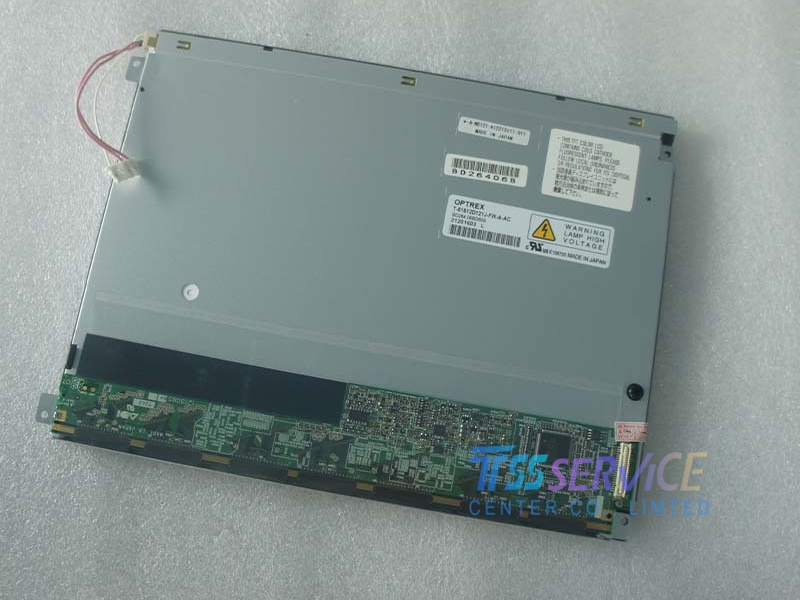
Decoding the Specifications: Resolution, Luminance, and Viewing Angle
To appreciate the OPTREX T-51512D121J-FW-A-AB, one must first dissect its mechanical and optical DNA. The panel is designed around a 12.1-inch diagonal active area, utilizing a-Si TFT (Amorphous Silicon Thin Film Transistor) technology. Its native resolution is typically XGA (1024 x 768 pixels), a standard 4:3 aspect ratio that remains highly prevalent in industrial control systems and medical monitors due to its compatibility with legacy software interfaces. The luminance output, powered by the twin CCFL tubes, is generally rated in the range of 400 to 500 cd/m² (nits). This is a significant performance metric; while lower than modern high-brightness LED panels, this level of luminance is carefully balanced to prevent glare in controlled indoor environments and to maintain consistent performance over the backlight’s lifespan.
The viewing angle specifications are equally critical. With a typical TN (Twisted Nematic) mode, the panel offers wide horizontal viewing (often 70 to 80 degrees in each direction) but more constrained vertical angles. This is a deliberate trade-off. In many industrial settings—such as a panel mounted in a machine console—the primary viewer is positioned directly in front of the screen. The narrower vertical angle helps reduce light leakage and contrast inversion from extreme angles, which can be a cognitive distraction in a control room environment. The response time, usually in the range of 10 to 25 milliseconds, is perfectly adequate for static data display and menu navigation, though it is unsuitable for dynamic video content. Understanding these parameters helps professionals select the correct replacement or design-in component for a specific operational context.
Power Management and the CCFL Backlight Challenge
The most distinguishing feature of this OPTREX model is its backlight technology: the Cold Cathode Fluorescent Lamp (CCFL). Unlike modern LED backlights which operate on low-voltage DC, CCFLs require a high-voltage AC inverter, typically ranging from 600V to 1000V RMS at start-up. This introduces a layer of complexity for the system integrator. The T-51512D121J-FW-A-AB likely contains two CCFL tubes. The power supply design must include a dedicated inverter board, which is a separate component from the LCD driver board. This inverter can be a significant source of electromagnetic interference (EMI) if not properly shielded and filtered
.
Furthermore, the power consumption profile is distinct. A CCFL backlight draws a constant current once lit, but its efficiency degrades over time (typically 30,000 to 50,000 hours to half brightness). This is a critical factor for maintenance planning. Designers must also consider the warm-up time; a CCFL can take several seconds to reach full brightness, especially in cold environments. For applications requiring instant-on visibility, this is a disadvantage. However, the color rendering of a correctly driven CCFL can be more uniform and consistent across the entire brightness range compared to some early PWM-dimming LED designs. Managing the inverter's output—often via a simple analog voltage or a PWM signal—requires careful attention to the datasheet's timing diagrams to avoid flicker or damage to the lamp.
Signal Interface, Timing, and Integration Pitfalls
The electrical interface of the OPTREX T-51512D121J-FW-A-AB is typically an LVDS (Low-Voltage Differential Signaling) input. This is a standard for industrial displays, utilizing a 20-pin or 30-pin connector. The interface carries the pixel clock, data lines, and control signals for horizontal and vertical synchronization. A crucial detail for the engineer is the data mapping. LVDS can be configured in JEIDA or VESA mapping formats. An incorrect mapping will result in severely skewed colors (e.g., a blue channel appearing red). The panel datasheet explicitly states the required mapping, and the host processor’s LVDS transmitter must be configured accordingly.
Timing parameters are equally specific. The panel expects a Dot Clock frequency of approximately 65 MHz for XGA resolution at 60 Hz refresh. Deviations from this can cause image instability or "noise" on the screen. A typical pitfall in integration is assuming all 12.1-inch panels are pin-compatible. They are not. The OPTREX T-51512D121J-FW-A-AB has a specific power sequencing requirement: the logic voltage (+3.3V or +5V) must be applied and stabilized before the backlight inverter is enabled. Reverse sequencing can latch up the driver ICs and permanently damage the panel. Additionally, the designer must account for the mechanical mounting. The panel typically requires mounting brackets that provide an air gap for airflow around the CCFL tubes, as heat dissipation is a more significant concern than with LED panels. Ignoring these integration steps can lead to premature failure in the field.
Conclusion
The OPTREX T-51512D121J-FW-A-AB 12.1-inch TFT-LCD display embodies the engineering trade-offs essential for long-life industrial applications. While its CCFL backlight introduces complexities in power management and requires careful thermal and maintenance planning, its robust optical performance and forgiving resolution make it a reliable workhorse for systems that cannot tolerate frequent upgrades. For the engineer tasked with supporting legacy equipment, mastering the integration of this display is not about avoiding modern technology, but about leveraging a proven solution where stability and color consistency are paramount. Proper attention to LVDS data mapping, power sequencing, and inverter design will ensure that this panel continues to serve its purpose effectively for years to come.


