In the rapidly evolving landscape of embedded displays, the balance between visual clarity, power efficiency, and physical form factor defines the success of modern human-machine interfaces.
In the rapidly evolving landscape of embedded displays, the balance between visual clarity, power efficiency, and physical form factor defines the success of modern human-machine interfaces. The TX23D12VM0CAA, a 9.0-inch TFT-LCD module offering 800×480 WVGA resolution, represents a specialized solution engineered for demanding industrial, medical, and instrumentation applications. Unlike consumer-grade panels that prioritize ultra-high pixel density, this display is built around the practical necessity of sunlight readability, wide temperature tolerance, and consistent grayscale performance. This article dissects the architecture of this specific model, moving beyond basic specifications to explore its optical engineering, interface logic, real-world durability, and the critical considerations for system integration. Engineers and procurement specialists will find a clear, data-driven analysis of why this particular panel remains a relevant choice in a market saturated with higher-resolution alternatives.
Optical Architecture and Viewing Performance
The TX23D12VM0CAA employs a Twisted Nematic (TN) technology layer combined with a normally white transmissive mode, which is a deliberate choice for applications requiring fast pixel response times. The 800×480 resolution, distributed across a 9.0-inch diagonal active area, yields a pixel density of approximately 104 PPI. While this is modest by smartphone standards, it is optimized for a viewing distance of 50 cm or greater, typical in industrial panels. The critical metric here is the contrast ratio, specified at 500:1 typical. This level of contrast ensures that text and simple iconography remain legible even under moderate ambient lighting, a common pain point for lower-end amorphous silicon panels.
One of the most overlooked aspects of this module is its 6 o'clock viewing direction. This means the optimal viewing angle is slightly below the normal line of sight, making it ideal for dashboard-mounted displays or devices placed on a countertop where the user looks down. The wide operating temperature range of -20°C to +70°C further confirms that the liquid crystal mixture and polarizer films are selected for thermal stability, preventing ghosting or color shift in unheated factory floors or outdoor kiosks. Furthermore, the inclusion of a single LED backlight (driven by 9 LEDs in series) simplifies the voltage rail design for the integrator, though it does require careful attention to constant current drive to prevent premature luminance decay.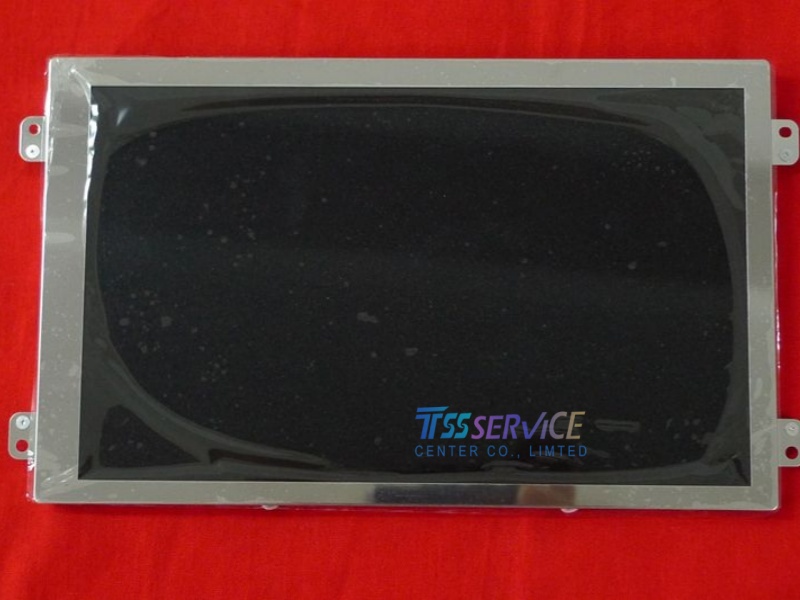
Interface Logic and Signal Integrity Challenges
At the heart of the TX23D12VM0CAA's connectivity is its parallel RGB 24-bit interface, which is a significant differentiator from modern LVDS or MIPI-based panels. This 50-pin connector demands a precise timing controller (TCON) or an FPGA capable of generating the required clock, data enable, horizontal sync, and vertical sync pulses. The 800×480 resolution at 60 Hz refresh rate requires a pixel clock frequency typically in the 33 MHz range. The challenge for the design engineer is managing signal integrity at this frequency over ribbon cables longer than 10 cm. Without careful PCB layout—matching trace lengths for the three color data groups (R, G, B) and the synchronization signals—issues such as pixel crosstalk or horizontal line jitter emerge.
-
Supply Voltage Rails: The module requires a single 3.3V analog supply for the gate drivers and a separate supply for the logic interface. Decoupling capacitors near the connector are mandatory.
-
Backlight Drive: A typical forward voltage of 18V-21V for the LED string demands a boost converter. The PWM dimming frequency should exceed 200 Hz to avoid visible flicker.
-
Signal Swing: The CMOS parallel interface expects 0V to 3.3V logic levels. Interfacing with a 5V microcontroller requires level shifting.
Understanding this interface is the key to troubleshooting display anomalies. Most failures in the field are traced not to the LCD glass itself, but to poor timing alignment between the host controller and the panel's required setup/hold times.
Durability Testing and Environmental Resilience
Industrial deployments are unkind to electronic components. The TX23D12VM0CAA is rated for a storage humidity of up to 90% RH non-condensing, which indicates that the polarizer edges are sealed against moisture ingress—a common failure point in cheaper panels. The module undergoes a rigorous vibration test profile of 10-55 Hz with a 1.5 mm amplitude, simulating the constant vibration found in forklift terminals or pump control stations. One specific design feature that supports this reliability is the stainless steel bezel and the rigid pin connection system, which reduces mechanical stress on the fragile chip-on-glass (COG) bonds during thermal cycling.
The panel's compliance with the RoHS 2.0 and REACH directives ensures that the halogenated flame retardants and phthalates are absent, which is not only a regulatory requirement but also reduces outgassing inside sealed enclosures. For engineers designing for medical devices (e.g., patient monitors), the low electromagnetic interference (EMI) profile of the parallel interface—when properly shielded—can simplify the path to IEC 60601-1 compliance. However, the lack of an integrated touch sensor in the standard module means that the mechanical stack must be carefully designed for an external capacitive touch panel, maintaining a minimal air gap to preserve optical quality.
System Integration Strategies and Practical Optimization
Successfully integrating the TX23D12VM0CAA extends beyond electrical connection; it requires a holistic approach to thermal management and firmware calibration. The LED backlight, consuming up to 3.5W, generates localized heat at the bottom edge of the module. In a sealed enclosure without a heatsink, the temperature can rise by 15°C above ambient, causing the liquid crystal to reach its clearing point if not ventilated. A recommended strategy is to use a thermal pad connecting the LED PCB to the metal enclosure chassis. On the software side, the panel's gamma curve defaults to 2.2, but the analog voltage levels for the grayscale should be verified with a colorimeter to ensure uniform brightness across the full screen, especially for medical imaging or machine vision applications.
-
Frame Buffer Requirement: A 24-bit color depth at 800×480 requires 1.15 MB of RAM. A double-buffering scheme is advised to prevent tearing.
-
Connector Selection: The standard 0.5mm pitch FFC connector requires a carefully selected actuator to ensure correct locking force.
-
Power Sequencing: The logic supply must power up before the backlight voltage. A simple MOSFET-based sequencing circuit can prevent inrush currents.
By treating the display not as a passive component but as a subsystem requiring its own power and signal conditioning, engineers can maximize the lifespan of this rugged panel.
Conclusion
The TX23D12VM0CAA 9.0-inch WVGA TFT-LCD is a testament to the principle that industrial display solutions prioritize reliability and functional clarity over raw pixel counts. Its TN technology, wide temperature range, and proven parallel interface make it a robust choice for applications where a display is a tool, not a lifestyle device. While the integration demands careful signal routing and thermal planning, the payoff is a component that can operate consistently for a decade in harsh conditions. For engineers seeking a display that delivers predictable performance without the complexity of modern high-speed interfaces, this panel remains a standard-bearer in the embedded world.


